Defining the Roles
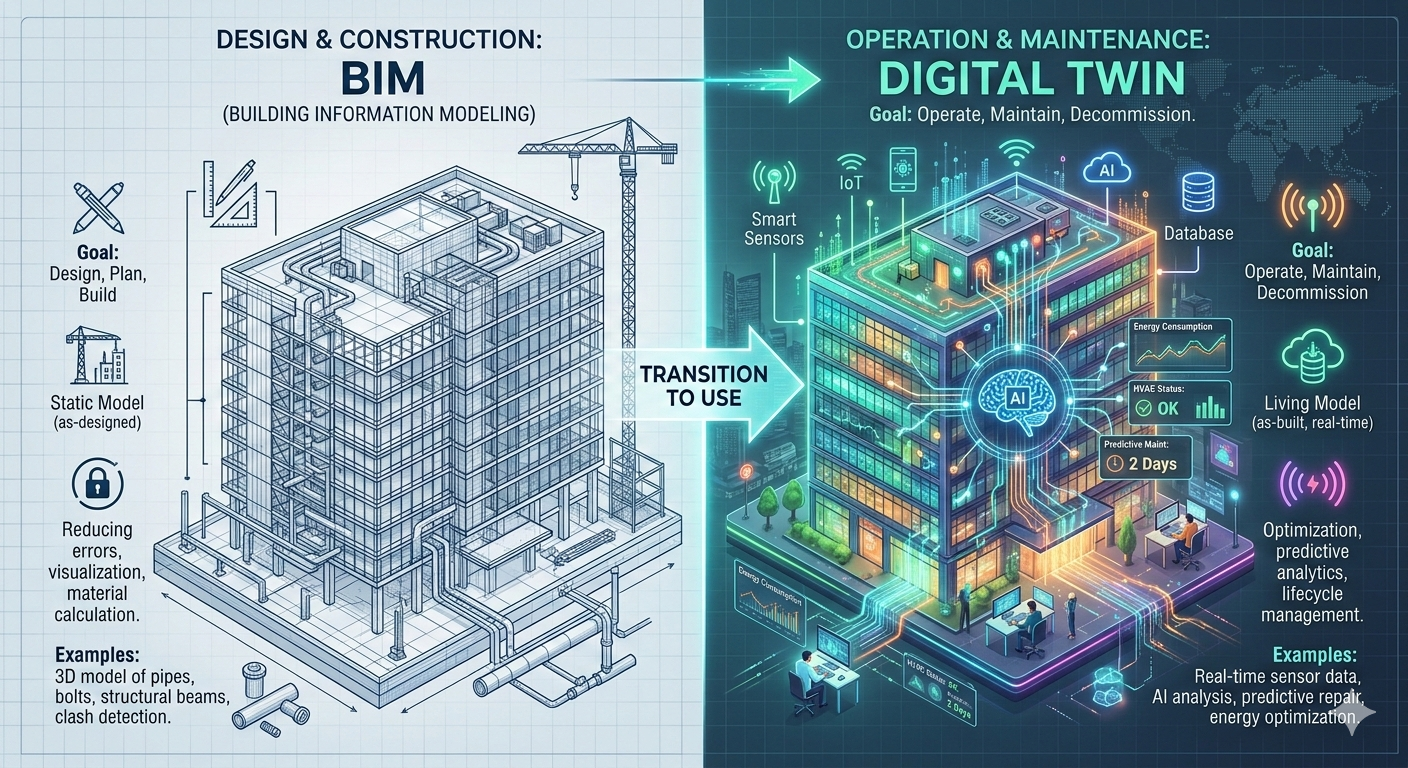
BIM is a precise digital representation of a building created during the design and construction phases. It is a tool for planning, estimating, and building.
A Digital Twin is a "living," automated virtual replica of a physical asset (be it a building, infrastructure, or equipment). It is constantly updated in real-time via sensors, IoT devices, and other data sources. Digital Twins are designed to assist in operation, maintenance, and eventual decommissioning.
Real-World Application Imagine an office building modeled in BIM. You know exactly where the pipes run, how the ventilation is structured, and what materials were used. But once the building opens, the BIM model remains static.
In contrast, a Digital Twin continues to evolve. It tracks the asset's condition throughout its entire lifecycle by collecting data from sensors to monitor climate control and equipment wear. It can automatically adjust system settings and even predict when repairs are needed.
Static Planning vs. Real-Time Reality: In BIM, you see how the lighting should work. In a Digital Twin, you see how it is working at this very second: when it turns on, how much power it consumes, and which areas are under-lit and why. It can pinpoint energy waste, suggest optimizations, and demonstrate the results of those changes immediately.
This is how it looks in the table:
| BIM | Digital Twin | |
|---|---|---|
| Task | Modeling | Monitoring, analysis, forecasting |
| Work | Static model | Dynamic, updated in real time |
| Data | Description of the facility before commissioning | The state of an object throughout its entire existence |
| Approach | Modeling | Data collection and intelligent support |
| Level | Architect and construction | Operational and analytical |
Powered by Artificial Intelligence (AI) and Big Data, Digital Twins are already being deployed in business centers, shopping malls, and industrial sites. In the near future, they will become an integral part of all infrastructure — from residential buildings to entire city management systems. A Digital Twin is not just an automation system; it is a technology that knows exactly what is happening in reality.