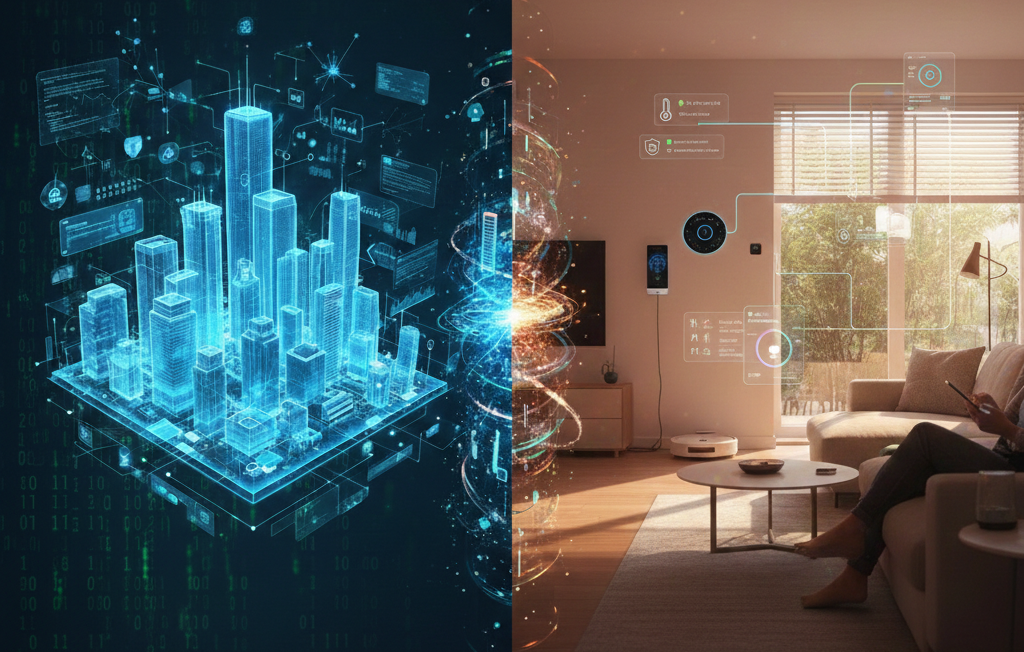
What is the difference?
A Smart Home operates based on pre-defined scenarios: someone sets the rules, and the system follows them. A Digital Twin, on the other hand, is a virtual replica of your property that "knows" in advance how to elevate your comfort. It collects data, analyzes system behavior, predicts wear and tear, identifies resource waste, and suggests fixes through dynamic scenarios.
Examples in Action: Climate Control: In an ordinary apartment, a Smart Home might turn on the AC at a specific temperature. A Digital Twin knows that at +30°C outside, your apartment overheats specifically between 2:00 PM and 5:00 PM because it faces the sunny side. It will lower the blinds in advance and optimize the cooling mode to save energy.
Efficiency: If your electricity bill spikes, a Smart Home stays silent—it doesn't care if the underfloor heating and the AC are "fighting" to heat and cool the room simultaneously. A Digital Twin analyzes all nodes, identifies why the heating stayed on or why the ventilation is running while you're away, and explains the cause (e.g., a malfunction).
You are left with a simple choice instead of a long investigation:
- Create a new scenario
- Or call maintenance
Let's compare:
| Smart Home | Digital Twin | |
|---|---|---|
| Task | Automation and comfort | Forecasting, modeling, automation and comfort |
| Work process | According to given scenarios and commands | In real time, based on collected data and dynamic scenarios |
| Approach | Reacts to events | Predicts, advises and optimizes |
| Level | Common | Engineering, analytical |
Today, Digital Twins are used in "smart" residential complexes and business centers to optimize HVAC and security. Driven by AI, these technologies are conquering the business world and are just beginning to enter the residential sector.
Tomorrow, even a studio apartment will have its own Digital Twin—not just to "execute," but to truly understand your home and lifestyle.